
~ ~ ~ ~ ~
This guide book has been prepared to provide accurate interpretive information and historical background
for the living history the public will see during this Civil War weekend.
Compiled by Jacob Bates & Kim Perlotto
Eighth Connecticut Volunteer Infantry, Company A.
~ ~ ~ ~ ~
Civil War at Fort Trumbull
“Fights for the Forts”
Spectator Event Schedule
August 13-14, 2022
Saturday, August 13, 2022
9:00 Camps Open to the Public
10:00 Military Dress Parade
11:00 Military Drill
12:00 Soldiers Eat Dinner
12:30 Living History Demos
12:30 Soldiers Prepare for Battle
1:00 Battle: The Siege of Ft. Macon
2:30 Frederick Douglass Addresses U.S. Troops
2:30 Living History Demos
3:00 Medical Demo
3:00 Music by Susquehanna Travellers
4:00 Camps Close to the Public
Sunday, August 14, 2022
9:00 Camps Open to the Public
9:10 Church Call
10:00 Military Dress Parade
10:30 Lincoln & Douglass Address U.S. Troops
11:00 Military Drill
11:00 Music by Susquehanna Travellers
12:00 Cooking Demos – U.S.
Civilian Camp
12:00 Soldiers Eat Dinner
12:30 Soldiers Prepare for Battle.
1:00 Battle: Battle of Ft. Wagner
3:00 Camps Close to the Public
~ ~ ~ ~ ~
Connecticut in the
Civil War
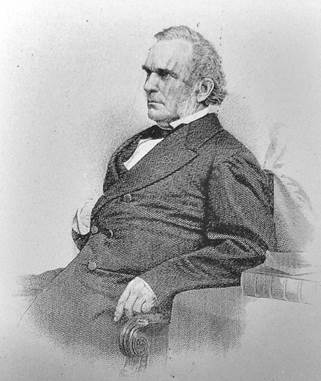
Governor William A.
Buckingham
Governor William A. Buckingham served as governor of
Connecticut for the entirety of the Civil War. He served eight one-year terms from 1858 through 1865. When the vote was predicted to be close during
Buckingham’s 1860 election, Abraham Lincoln himself was pulled away from his
tour of New York, and came to Connecticut to speak on behalf of Buckingham
and the Republican party. Abraham Lincoln spoke five times in total in the
state, securing Buckingham this important election, and securing Lincoln Connecticut's support during the war.
Buckingham proceeded to purchase equipment for the volunteer
regiments forming early in the war by borrowing funds under his own name in
order to get the skids greased while the legislature pondered allocations for
the state war effort.
In his second election, during the war, Governor Buckingham won his position almost exactly by the number of votes cast
by Union soldiers who were furloughed to return home and vote. The Democratic
Party called this act “fraud", and political tensions ran extremely high in Connecticut
throughout the war.
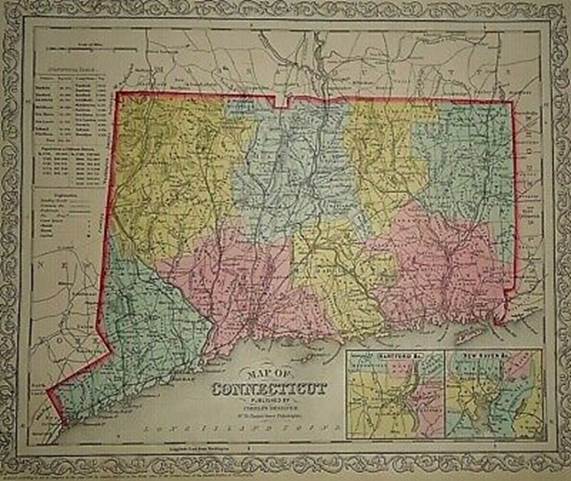
Map of Connecticut 1860
55,000 Connecticut men between joined the Union Army as
volunteer soldiers during the American Civil War. 47% of all eligible white men
answered the call, while 78% of all black men enlisted as soldiers. The
enlistment rate, especially in Connecticut “colored” regiments is extremely
impressive. 10% of all white Connecticut soldiers would be killed, and wounded
mentally and physically, or simply go missing - lost forever to the records of history.
An even higher amount, 15% of Connecticut “colored” soldiers became casualties,
killed, wounded, or missing, by the war’s end.
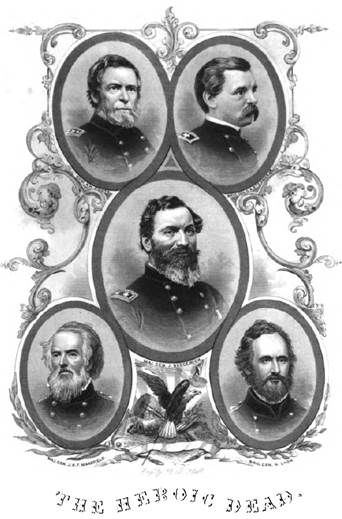
Several famous Union generals were born in
Connecticut, including Nathaniel Lyon, Joseph Mansfield, Griffin Stedman, and John
Sedgwick. Joseph Mansfield was killed, at the Battle of Antietam, while urging
his men forward. General John Sedgwick, who jokingly said “They couldn’t hit an
elephant at this distance,” to encourage his men, was killed only moments later when
a Confederate sharpshooter fired a bullet into his skull. Sedgwick was one of
the most experienced commanders in the entire Army of the Potomac, and had served
his country for four years before his death. When General Grant himself, in
charge of the entire United States Army, heard the news of Sedgwick’s death he
remarked in shock “Is he really dead?” Finally stating that the loss of
Sedgwick was "greater than the loss of a whole division of troops."
Connecticut soldiers and generals prosecuted the war for the
Union cause. But Connecticut’s manufacturers and home front contributions were
absolutely instrumental in winning the American Civil War.
The women of Bridgeport formed the first women’s aid society in the United States, Civilians began to help in every aspect of the war effort, from volunteering with the U.S Sanitary Commission, to manufacturing buttons, bullets, and firearms. Connecticut even employed state agents to check on the condition and ensure safe travel for the state’s volunteer soldiers.
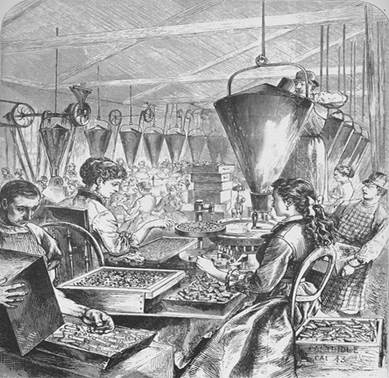
Civilians working at the Bridgeport Munitions
Factory
Ellen M. Sprague from Andover Connecticut hid a letter to
whichever Union soldier received her package of new socks, a very welcome
present after a march which could exceed twenty miles. “My dear Friend and
brother in our Country’s cause: To your care and keeping I commit these socks,
and trust they may never be disgraced by any conduct of their wearer. Loyal fingers fashioned them, and may a
patriot’s tread, whose very step shall tell against our rebel foes, wear them
threadbare (if need be) in crushing the wicked rebellion. In every stitch is knit a prayer for our
nation’s weal, and the hope that peace may smile upon our land long ere these be unfit for use.”
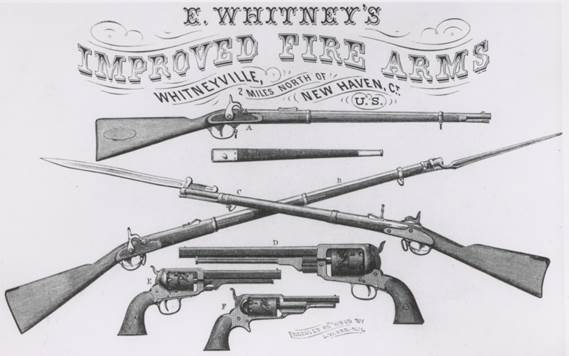
Eli Whitney Fire Arms Advertisement
Manufacturers of war materiel included Colt Firearms, Whitney
Firearms, Savage Firearms, Ames Iron Works, and Scoville Company in the “Brass
Capital of the World”, Waterbury Connecticut. Manufacturers produced vital
weaponry and equipment supplying Union soldiers across the entire nation.
Connecticut was on the cutting edge of innovation as 70 patents were secured by
Connecticut manufacturers during just the first two years of the war alone,
with 75% being for weaponry. One Connecticut factory had even created the pikes
used in John Brown’s raid on Harpers Ferry, which sparked the American Civil
War.
Although Connecticut Republicans had abolitionist factions, the
state Democrats included a fair amount of anti-abolition and “pro-peace”
citizens. Hardly any Connecticut citizens supported southern independence, but nearly
half the population believed peace should be made and no war should be fought. The
question of emancipation versus abolition was constantly hanging in the political
balance throughout the war. Connecticut was referred to as the “Georgia of New
England,” where progressive people were offset by steadfast traditionalists.
After the war was over, veteran groups, towns, cities, and the state proposed, sponsored, and erected monuments to the soldiers, both martyrs and survivors, and to the preservation of the Union. There are one hundred and thirty Civil War monuments around the state of Connecticut. They are true markers of the impact this conflict had on Connecticut, and of the lasting effect the war had on its people. One of the first Civil War monuments in the country was erected in Kensington in 1863, before the war was over.
SOURCES:
Matthew Warshauer.
Connecticut in the American Civil War. Wesleyan University Press, Middletown,
CT, 2011.
“William Alfred Buckingham”. Wikipedia. Retrieved August 2, 2022, from
https://en.wikipedia.org/wiki/William_Alfred_Buckingham
“March 5: Abraham Lincoln Speaks in Hartford”. Today in Connecticut History. Retrieved August 2, 2022, from
https://todayincthistory.com/2019/03/05/march-5-abraham-lincoln-speaks-in-hartford/
“The complicated realities of
Connecticut and the Civil War”. CTHumanities Project (2021,
December 19). Retrieved July 26, 2022, from https://connecticuthistory.org/connecticut-and-the-civil-war/
"The Death of John Sedgwick." American
Battlefield Trust. (2021, March 26). Retrieved July 26, 2022, from https://www.battlefields.org/learn/articles/death-john-sedgwick
“Civil War - Connecticut History” CTHumanities Project (2011, December 28). Retrieved July
26, 2022, from https://connecticuthistory.org/topics-page/civil-war/
~ ~ ~ ~ ~
Fort Trumbull in
the Civil War
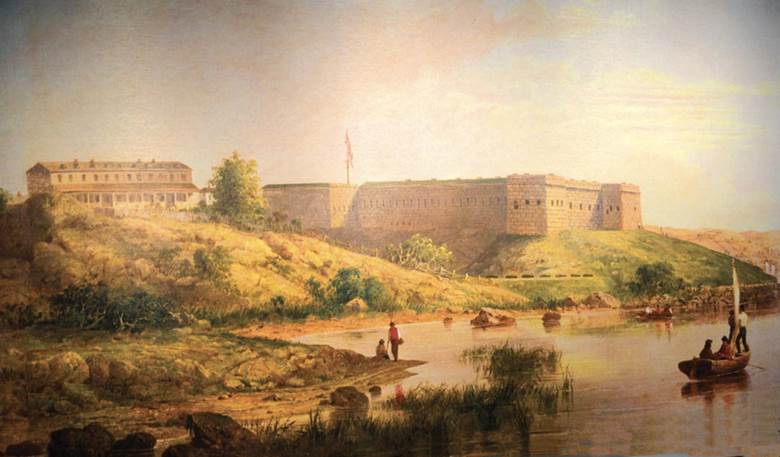
“Fort Trumbull” by Seth Eastman 1870
The first fort on this site was built by direction of Governor Jonathan Trumbull in 1775, to protect the port of New London and the seat of government for Connecticut. It was attacked in 1781 during the famous Benedict Arnold raid on New London.
Fort Trumbull as we see it today is a stone fort, the third and most impressive fortification to be constructed on this ground. It was constructed between 1839 and 1852 and stands as a five-sided, four-bastion stone fort intended for coastal defense. It could accommodate 42 guns on the seacoast fronts, plus 10 additional guns in two flanking batteries outside the fort, along with flank howitzers in bastions for close-in defense.
Army engineer George Washington Cullum was in charge of
construction for Fort Trumbull. Cullum later served as superintendent of the
United States Military Academy at West Point. Upon review of Fort Trumbull in
1870, the Surgeon General noted in his report on Barracks and Hospitals that
Fort Trumbull incorporated “the latest improvements in the science of defense
and gunnery.”
The 14th Infantry Regiment of the Regular United States Army
was organized and stationed at Fort Trumbull at the outbreak of the American
Civil War. The 14th U.S, known as the “Golden Dragons” would use Fort
Trumbull as their headquarters and recruitment center. The 14th Infantry
battled in Virginia throughout the Civil War and fought in truly notable
campaigns. They fought in the Peninsula Campaign, Manassas, Antietam,
Fredericksburg, Gettysburg, Wilderness Campaign, and Petersburg, to name a few
of their engagements. The 14th hosted 24 companies, as opposed to the usual 10, and
thus was known as a “super sized” infantry regiment.
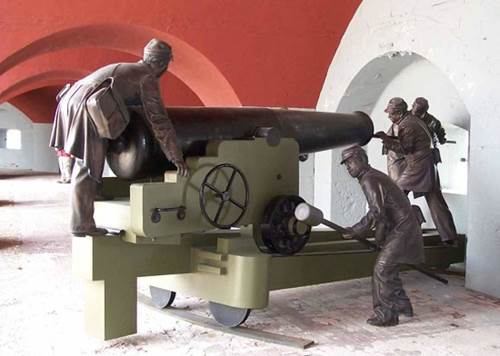
Manning the Guns in the Casemates of Fort Trumbull
Famed Major General John F. Reynolds, of Gettysburg glory,
commanded the 14th U.S Infantry at Fort Trumbull early in the war as a
Lieutenant Colonel. He later would rise through the ranks and become one of the
highest-ranking Union officers to be killed in the entire Civil War, when he
was shot through the neck at the Battle of Gettysburg.
For the remainder of the Civil War, Colonel William Gates
commanded Fort Trumbull. Gates was a West Point graduate, and had served in the
army for more than 50 years. Though he was retired, Gates was awarded the
command of Fort Trumbull as a means of income, and in honor of his experience.
Fort Trumbull served many military roles since the Civil War including: home of the US Coast Guard Academy, Merchant Marine Officers Training School, University of Connecticut branch, and the Naval Underwater Sound Laboratory. The fort was finally closed in 1996. It was opened as a Connecticut state park in 2000.
The Fort served its country well throughout the entire American Civil War, and while Fort Trumbull itself did not see combat, forts which look strikingly similar, such as Fort Macon in North Carolina, were besieged during intense battles of the war. This similarity makes Fort Trumbull a perfect location to host today's Civil War Reenactment event.
SOURCES:
“Fort Trumbull State Park:
Overview/History”, accessed July 24, 2022.
https://portal.ct.gov/DEEP/State-Parks/Parks/Fort-Trumbull-State-Park/Overview
“Fort Trumbull”, Wikipedia, accessed July 24, 2022, https://en.wikipedia.org/wiki/Fort_Trumbull
U.S. Army Center of Military History
- Prints & Posters - the Eastman Forts. (n.d.). Retrieved July 26, 2022,
from https://history.army.mil/html/artphoto/pripos/eastman.html
Fort Trumbull, Connecticut. U.S.
Senate: Fort Trumbull, Connecticut. (2021, January 28). Retrieved July 26,
2022, from https://www.senate.gov/art-artifacts/fine-art/paintings/33_00017.htm
Fort Trumbull - A history. (n.d.).
Retrieved July 26, 2022, from https://web.archive.org/web/20091026194651/http://www.geocities.com/~jmgould/trumhist.html
~ ~ ~ ~ ~
Siege of Fort Macon
Bogue Banks, North Carolina
March 23 - April 26, 1862
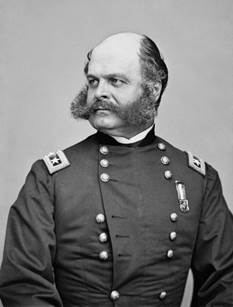
Maj. Gen. Ambrose E. Burnside
The Union’s strategic Anaconda Plan included “The Burnside Expedition” to take control of the North Carolina coast. After the successful battles at Roanoke Island and New Bern, General Ambrose E. Burnside turned his attention next on Fort Macon.
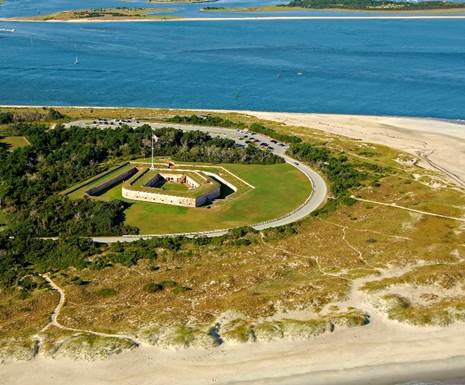
Fort Macon on Bogue Banks
Fort Macon built after the War of 1812, as part of the Third System of coastal fortifications. It was built on the eastern end of the barrier island called Bogue Banks, at the southern end of the Outer Banks chain. The fort was located there to defend the entrance to the ports of Beaufort and Morehead City.(1) These ports were strategically important prizes for the Union, to prevent blockade runners from operating out of these ports. It was also targeted since the North Atlantic Blockading Squadron lacked a deep-water port in the area for coaling and supply.
New Bern was captured on March 14. Burnside then ordered Brigadier General John G. Parke, commander of the Coast Division's Third Brigade, to advance, control, and capture the fort.(1) Parke moved south from Newbern, landed at Slocum’s Creek, and worked inland. He seized the towns along the inner shore: Carolina City on March 21, Morehead City on March 22, Newport on March 23, and finally, Beaufort on March 25.(1) They had thus captured control of the railroads from New Bern to Morehead to send the siege train forward. Parke's Third Brigade included the 8th Connecticut, 9th New Jersey, 4th Rhode Island, and 5th Rhode Island, along with 1st U.S. Artillery, Battery C.
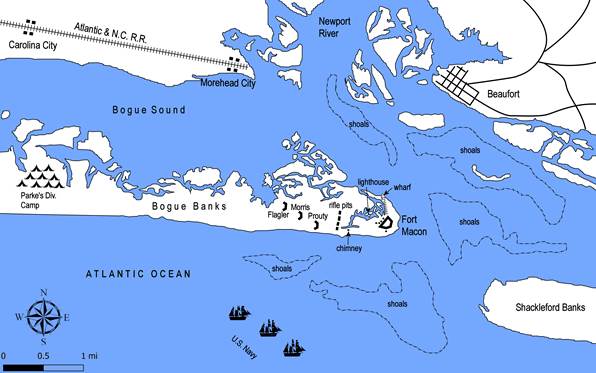
Map of Fort Macon and Vicinity
The garrison of Fort Macon at this time, numbered about 430 officers and men, commanded by Colonel Moses J. White.(2) The fort was manned by five companies of the First North Carolina Artillery. Sickness reduced the garrison by about a third. Morale among the men was generally not good, as they were cut off from their families, and White was unpopular, both with his men and with the people of Beaufort.(2) Fort Macon had a total of 56 pieces of artillery mounted, (5 8-inch and 2 10-inch columbiads, 19 24-pounders, 32 32-pounders, and 6 field guns) but they only had enough ammunition for about three days of action.(5)
On March 23, General Parke sent a message to Colonel White, demanding the surrender of the fort. He offered to release the men on parole if the fort was turned over intact. White replied tersely, “I have the honor to decline evacuating Fort Macon.” The siege can be regarded as starting with this exchange.(5)
The investment of the fort began on March 29, when infantry from Parke's brigade crossed the sound and landed unopposed at Hoop Pole Creek on Bogue Banks. The infantry support on the island included seven companies of the 8th Connecticut. Federal siege artillery followed. Parke initiated work to set up three batteries to bear on the fort.(1) Lieutenant Flagler's Battery of 10-inch mortars at 1680 yards, Captain Morris's Battery of Parrott Rifles at 1480 yards, and Lieutenant Prouty's Battery at 1280 yards from the fort, comprised the Union arrayed batteries.(2)
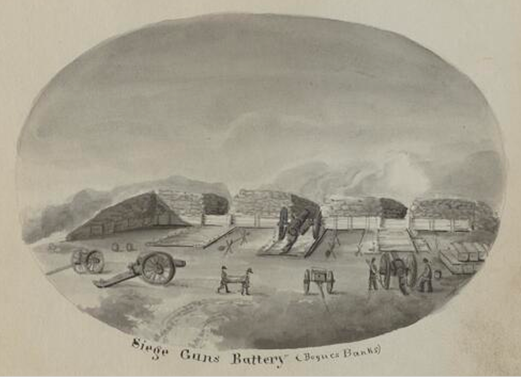
Sketch by Cor. Joseph Shadek, 8th Conn. Vols., Co. A.
The batteries were set at night and remained hidden behind sand dunes until they were ready to open fire. The defenders were aware of these activities, but could not waste ammunition by firing at unseen targets. Patrols sent out from the fort to harass the Union soldiers were driven back, usually without loss.(1)
On April 12, General Parke ordered five companies of the 8th Connecticut, under the command of Major Hiram Appelman, to advance and drive the Confederate pickets back into the fort. Appelman marched the battalion by the right flank along the beach until they reached a point about three miles from the fort, where they formed in line of battle across the width of the island. With Company G under Captain James L. Russell deployed as skirmishers, the Eighth continued forward. They engaged the enemy skirmishers and drove them back into the fort.(8)
On April 21, rifle pits were dug at night within 2,000 feet of the fort and were continuously occupied. The 8th Connecticut and 5th Rhode Island alternated on duty. On the evening of April 21, General Parke ordered the rifle pits be dug closer to the fort, so sharpshooters could try to silence the Confederate guns. A volunteer force from the 8th Connecticut, commanded by Major Appelman and under the direction of First Lieutenant Henry F. Morgan, began to dig these pits near the chimney of a ruined house. However, as First Sergeant Amos Clift of Company G was positioning the pickets, the Confederates discovered the attempt to move closer, and they opened fire on the men with canister, wounding Major Appelman in the thigh and Private J. H. Alexander in the body.(8)
Preparations were completed by April 23, and on that day General Burnside communicated directly with Colonel White and repeated his demand for surrender, again offering to release the prisoners on parole. Colonel White once more refused, so on April 24, Burnside ordered General Parke to begin the bombardment as soon as possible.(6)
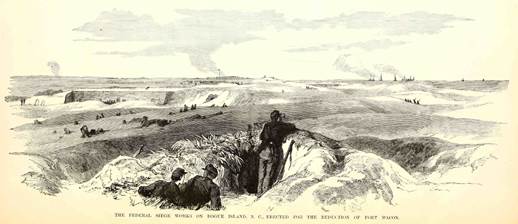
View of Fort Macon from Union Rifle Pits
In accordance with the procedure of alternating twenty-four hour shifts with the Rhode Island troops, the 8th Connecticut went on duty at the batteries at 9 p.m. on the evening of Thursday, April 24. Lieutenant Wolcott Marsh with Company A realized that the bombardment would commence the next day because he saw the artillery men busy opening the embrasures of the battery and exposing their guns to the enemy. Seeing this happen, Marsh ordered his men to dig a trench parallel to the battery to provide them with as much protection as possible.(8)
The Union bombardment began at dawn on April 25. At first, the gunners in the fort manned their pieces and replied vigorously, but they were unable to inflict damage on the Federal guns protected by the dunes. (6) The 8th Connecticut was on duty throughout that day, supporting the batteries, dodging incoming rounds in the trenches, and manning the forward rifle pits to harass the enemy gunners. The defenders were distracted by the appearance of four vessels from the Blockading Squadron: the steamers USS Daylight, State of Georgia, and Chippewa, and the bark Gemsbok. The Navy also supplied a pair of floating batteries to the attack.(1)
The Union bombardment lasted all day. About 1100 rounds were fired. Inside the fort, nineteen guns were dismounted. The walls of the fort began to crumble under the continued pounding, and in mid-afternoon Colonel White began to fear that the magazine would be breached. At 4:30 p.m., he decided that the fort could no longer hold out, so he ordered that a white flag be raised. Firing on both sides then ceased.(6)

Brig. Gen. John G. Parke

Col. Moses J. White
Colonel White met with General Parke to discuss terms, and Parke at first demanded unconditional surrender. White asked him for more favorable conditions, and referred to the terms that General Burnside had offered on March 23. Parke did not concede, but agreed not to renew the bombardment until he could consult with Burnside, who agreed to adhere to his first terms. The men in the fort were allowed to give their paroles, meaning that they would not take up arms against the United States until properly exchanged. They then were permitted to return to their homes, taking with them their personal property.(4)
The 8th Connecticut was relieved by the 5th Rhode Island at about 9 p.m. and returned to camp. Lieutenant Marsh wrote that they had been under fire for eleven hours and had to sit doubled up in trenches where the sand would cover them either in a shower or in a cave in.(8)
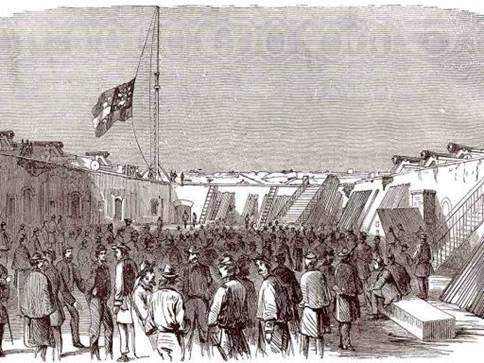
Confederates Lower Their Flag
Shortly after dawn on April 26, the Confederate flag was lowered, the defenders marched out, and the Union soldiers of the 5th Rhode Island marched in.(4) Fort Macon, Beaufort, and Morehead City were now in the hands of the Union, and no longer of use to the Confederacy.
Burnside sent the Confederate garrison flag to Rhode Island in the name of the 5th Rhode Island Battalion. The 8th Connecticut felt they had suffered the most during the siege and therefore should have the flag. But for their ill fortune of being relieved by the 5th Rhode Island that morning they would have been the ones to receive the surrender. General Parke later put forth the somewhat weak excuse that the regiment had not received the surrender because all of its field officers were sick or wounded, and therefore not present. The fact that Rhode Island was Burnside’s adopted state was probably not lost upon the Connecticut men as well.(2)(7)
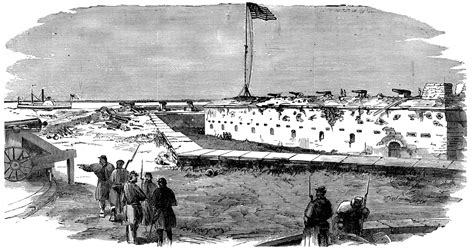
Union Soldiers Examine Siege Damage
SOURCES:
(1) “Siege of Fort Macon,” Wikipedia, Accessed July 10, 2022, https://en.wikipedia.org/wiki/Siege_of_Fort_Macon .
(2) Branch, Paul Jr. The Siege of Fort Macon. Morehead City, N.C.: Herald Printing Company, 1982.
(3) Burnside, Ambrose E. The Burnside Expedition. Providence, RI: N. Bangs Williams & Company, 1882.
(4) "Early Coast Operations in North Carolina." Rush C. Hawkins, Battles and Leaders of the Civil War Volume 1: The Opening Battles. New York, NY: The Century Co., 1884.
(5) Trotter, William R. Ironclads and Columbiads: The Civil War in North Carolina, The Coast. Winston-Salem, NC: John F. Blair Publisher, 1989.
(6) U.S. War Department, R.N. Scott, H. M. Lazelle, G.B. Davis, L.J. Perry, J.W. Kirkley, F.C. Ainsworth, et al. The War of the Rebellion: A Compilation of the Official Records of the Union and Confederate Armies. Washington, D.C.: U.S. Government Printing Office, 1880-1901. Series I, Volume 9, Serial 9.
(7) Croffut, W. A. and John M. Morris. The Military and Civil History Connecticut During the War Of 1861-65. New York, NY: Ledyard Bill, 1868.
(8) Liska, William A., and Kim L. Perlotto. The Eighth Connecticut Volunteer Infantry in the Civil War. Jefferson, N.C.: McFarland & Company, 2022.
LINKS:
Fort Trumbull State Park
https://portal.ct.gov/DEEP/State-Parks/Parks/Fort-Trumbull-State-Park
Fort Macon State Park History Brochure
https://www.ncparks.gov/fort-macon-state-park/home
Eighth Regiment Connecticut Volunteer Infantry
~ ~ ~ ~ ~
Second Battle of Fort Wagner
Morris Island, Charleston, South Carolina
July 18, 1863
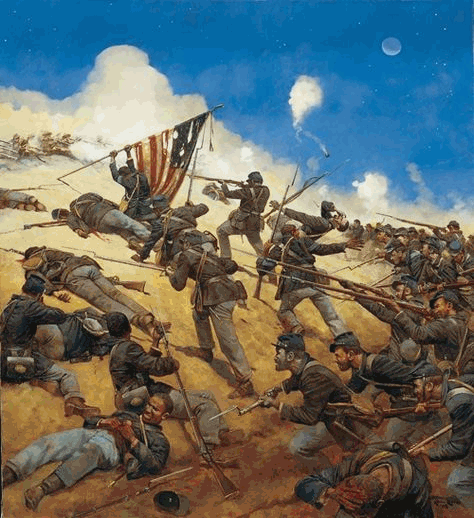
“54th Mass. Assaults Fort Wagner” by Keith Rocco
“Whenever its folds
shall be unfurled, it will mark the path of glory” Governor Andrew of
Massachusetts stated, as he presented the 54th Massachusetts, the first all-black
regiment in the United States Army raised in the north.
“Volunteers of African descent” from 22 states, including
Connecticut, filled the ranks of the 54th Regiment including former slaves and
two sons of the famous Frederick Douglass.
On July 18, 1863, four months after their departure from
Boston, the men of the 54th were faced with their biggest challenge of the war
- to capture an impressive Confederate fort, known as Fort Wagner, located in
the heart of secession, Morris Island, near Charleston, South Carolina.
The strategic importance of capturing Fort Wagner was seen
as paramount to toppling a series of Confederate Forts in South Carolina.
This strategy
was devised by U.S. General Quincy Gilmore, as a joint operation with the
United States Navy under Admiral David Farragut, and United States Army.
General Strong carried out the offensive successfully, seizing 150 Confederate
prisoners, twelve cannons, and five flags, and likely could have captured Fort
Wagner itself, but the assault was postponed due to feeling that the success of
the attack had already been so great.
However, as the Confederates were now given time to prepare
for the coming assault, the capture of Fort Wagner for soldiers of the 6th
Connecticut and 54th Massachusetts was a nearly impossible task.
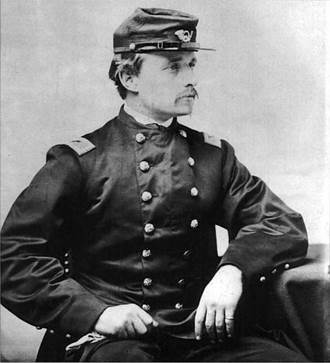
Colonel Robert Gould Shaw
The Harvard graduate, veteran of Antietam, and son of
prominent Boston abolitionists, Colonel Robert Gould Shaw, commanded the 54th
Regiment. Shaw, and all other white officers of the regiment understood that,
should they be captured, all were subject to the same fate as their black
soldiers - death.
The 54th Massachusetts formed for the assault on the sandy
banks of Morris Island. Brigadier General George C. Strong, commanding their
First Brigade, beckoned to the soldiers “Is
there a man here who thinks himself unable to sleep in that fort tonight?”
General Strong then, grasping the national colors and
pointing at their bearer, yelled “If
this man should fall, who will lift the flag and carry it on?” Colonel Shaw
himself stepped forward announcing “I will.” Adjutant Garth Wilkinson
James wrote that this response brought forth “the deafening cheers of
this mighty host of men, about to plunge themselves into the fiery vortex of
hell.” Colonel Haldimand S. Putnam, commanding the Second Brigade, warned
his officers “We are all going into Wagner like a flock of sheep.”
Cannonade from the land and sea roared at Wagner, the largest bombardment of the entire war to date. Eleven ships fired their guns as four land batteries let loose a deafening fire.
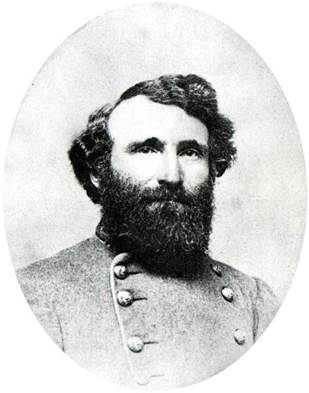
Brig. Gen. William B. Taliaferro
Although most of the Confederates were safe within Wagner’s massive bombproof, the strain was immense as the structure reeled and shook around them. Brigadier General William B. Taliaferro, the commanding southern officer at Fort Wagner, was a veteran of Stonewall Jackson’s campaigns and numerous engagements. He wrote of the bombardment, “Words cannot depict the thunder, the smoke, the lifted sand and the general havoc; the whole island smoked like a furnace and trembled as from an earthquake!” The General was covered to his waist in sand and dirt which piled up from the hellfire of cannonade, and his men were showered with debris. Only a small number were actually killed by the bombardment, and this proved fatal for the assaulting Union forces.
The Confederate flag was cut down from the pole during the
barrage. Captain Robert Barnwell planted a regimental flag on the parapet of
the fort to show the Union forces that the garrison had not surrendered, and
were ready for the coming fight.
Colonel Shaw raised his glittering sword, and the 54th Massachusetts commenced their lead of the assault on Fort Wagner.
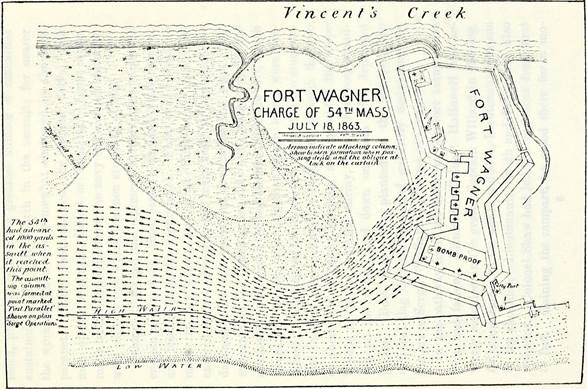
Map of the 54th
Massachusetts Assault
The Union artillery ceased, and Confederate defenders under
General Taliaferro prepared their own cannon, and rifles, before opening up a
deadly fire. One Union soldier described that a “sheet of flame…followed by a running fire, like electric sparks!”
was seen from the Confederate earthworks.
As the 54th charged up the banks of Fort Wagner, Colonel Shaw yelled “Onward 54th!” before falling dead with three fatal wounds.
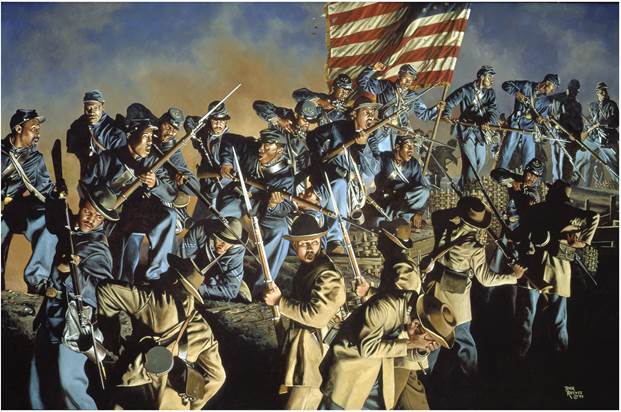
“The Colors Never
Touched the Ground” by Rick Reeves
As the fighting became point blank, two more officers of the 54th fell dead, and the National colors were shot down. Sgt. William Carney dropped his rifle and seized the flag, successfully carrying it all the way to the rear of the Union lines to safety, under fire the entire way. He was wounded multiple times and refused to place the flag in the care of anyone except men of the 54th Regiment. When he finally reached a squad of men from the 54th and their Lieutenant, a jubilant cry arose from white and black soldiers alike.
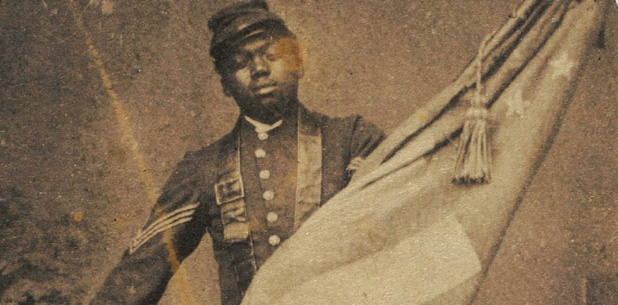
Sgt. William Carney, 54th Mass. Vols.
The Massachusetts state flag was ripped from its staff
during hand-to-hand combat, and was discovered after the fight, buried beneath
a pile of dead bodies.
Having seen the chaos and carnage, now the men of the 6th
Connecticut Volunteer Infantry were ordered to make the charge on Fort Wagner.
Commanded by Colonel John L. Chatfield, the 6th began to assault the right side
of the fort.
As the 6th Connecticut advanced, the men cheered and charged
the Confederate works, smashing into the line at its weakest point and causing
a temporary Confederate rout. Colonel Chatfield was mortally wounded during the
assault, with his leg and sword being hit. Pvt. Haffy
of the 6th placed himself between the deadly fire and the Colonel, and
attempted to pull him back to safety. The 6th Connecticut planted their colors
on the ramparts of the fort. These colors would be shot down and raised again
in defiance repeatedly throughout the fight.
General Taliaferro eventually was able to rally his North
Carolinians into the gap, but for many minutes, the fight seemed that it may
swing either way. Though other New Englanders followed in the footsteps of the
6th Connecticut, they were all sandwiched between the enemy and their own men, which
caused a terrible friendly fire as well. Paired with the hellfire from friend
and foe alike, Confederate howitzers fired canister shot, ripping down Union
men. All Union regiments were eventually forced back. Those who did not retreat
were killed or captured.
The wounded General Strong finally gave the order, “Retreat in the best order you can!” The second assault on Fort
Wagner was over. The legacy of the 54th Massachusetts had just
begun.
SOURCES:
“Fort Wagner and the 54th Massachusetts
Volunteer Infantry.” American Battlefield Trust, 25 Mar. 2021, https://www.battlefields.org/learn/articles/fort-wagner-and-54th-massachusetts-volunteer-infantry.
“Assault of Fort Wagner and Death of
Robert Gould Shaw.” History.com, A&E Television Networks, 13 Nov. 2009, https://www.history.com/this-day-in-history/assault-of-battery-wagner-and-death-of-robert-gould-shaw
.
Official records, Series One, Volume
XXVIII, Part Two, Page 15: Special
Orders No. 399, HDQRS. DEPT. Of the South, Hilton Head, Port Royal, S. C., July
6, 1863
“Second Battle of Fort Wagner”, Wikipedia, Accessed July 24, 2022, https://en.wikipedia.org/wiki/Second_Battle_of_Fort_Wagner
~ ~ ~ ~ ~
Music in the
Civil War
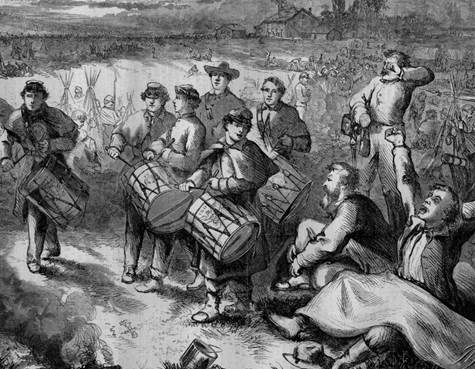
“Reveille in Camp”
“I don’t think we can have an army without music” - Robert
E. Lee, Confederate General
Music played a vital part in morale and patriotism in the
American Civil War from the battlefield, to the campfires, and parlors of
mansions north and south. Field music consisted of Fifers and Drummers who were
members of each company. These boys and men had the
vital role of waking the army up every morning with the tune of “Reveille,” a
very unwelcome sound at 6:30 A.M. The drummers and fifers kept soldiers in step
as columns of men marched twenty miles a day, and even sounded specific calls
for soldiers and officers on the battlefield, to recognize.
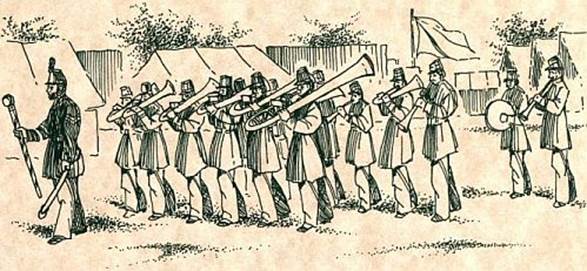
A Civil War Brass Band
Brass bands struck up patriotic music for official
ceremonies, and professional singers belted operatic style music in parlors and
performance halls all over the north and south. One Confederate Brass Band even
aided P.G.T Beauregard’s army to escape from their positions in Corinth
Mississippi. In an early form of spy craft, the Brass Band moved along the
former Confederate line playing tunes to simulate the Confederate forces still
occupying the area. This strategy paid off for the army, but not the brass
band, all of whom were captured.
The most influential type of music that was developed during
the war was that of string bands. The myriad of folk styles played by these
bands have influenced modern music that we hear today in so many ways. Many songs that you may know today had their origins in the Civil War time
period.
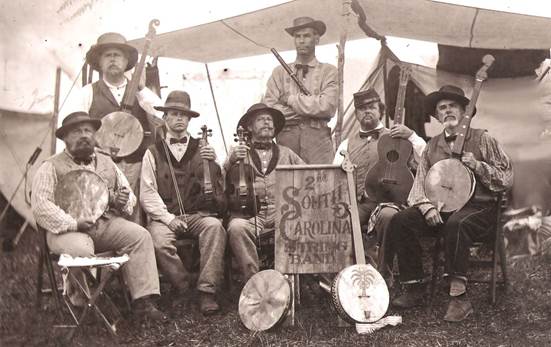
The Second South Carolina String Band
From the Appalachian Mountains, to the minstrel shows of Virginia, to the campfires of the Army of the Potomac, string bands played songs of home, war, patriotism, country, and love. The guitar, banjo, fiddle, tambourine, bones, flute, tin whistle, jaw harp, and piano are some of the most common instruments found in camp and at home during the American Civil War.
Confederate Cavalry General J.E.B Stuart often kept a
personal string band at his headquarters at all times, and reportedly went into
battle with a banjo player on a few occasions. Steven Foster, one of the
greatest American composers of all-time, created numerous songs prewar and
during the war, which are popular even to this day.
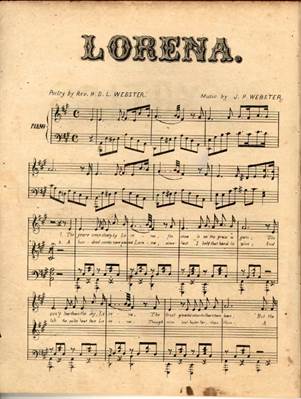
The invention of the printing press allowed “songsters” and
sheet music to be distributed widely to soldiers, with 10,000 original songs on
sheet music being produced during the four years of the war. Both sides had
their own ballads and tunes, with some even being parodies of the other side.
African-American soldiers influenced even southern music, with their catchy
spirituals and work songs. The songs that transported soldiers back to home and
lead them to imagine better times, or that raised their spirits to prepare for
battle, played an absolutely vital role.
SOURCES:
“Music of the Civil War.” The
Kennedy Center, https://www.kennedy-center.org/education/resources-for-educators/classroom-resources/media-and-interactives/media/music/music-of-the-civil-war/
.
Pruitt, Sarah. “How the US Civil War
Influenced Music.” History.com, A&E Television Networks, 25 Jan. 2021, https://www.history.com/news/civil-war-music-influence.
Ewers, Joe. Civil War Music. 2nd South Carolina String Band, http://civilwarband.com/ .
~ ~ ~ ~ ~